

Stylish Wellness Devices for Busy Professionals

Table of Contents
- Quick Comparison: Top Stylish Wellness Devices
- How to Build a Minimalist Skincare Routine with Smart Devices
- Best Health Gadgets for Office Workers: Recovery and Focus
- Wearable Wellness Devices for Professionals: What Actually Works
- Design-Forward Wellness Devices That Double as Decor
- What to Ignore: Common Bad Advice About Wellness Tech
- Conclusion
- Frequently Asked Questions
Last Updated: September 13, 2026
Quick Comparison: Top Stylish Wellness Devices
Wellness devices are tools designed to support physical recovery, skin health, sleep, and stress management at home. This guide from The Pure Shelf covers the most practical options for busy professionals who want results without clutter.
The best stylish wellness devices for busy professionals balance three things: they fit a real daily routine, they look good enough to leave on a desk, and they solve a specific problem. Below, we break down recovery tools, light therapy, wearables, and design-forward pieces, plus the advice you should ignore.
| Device | Price | Best For | Where It Fits |
|---|---|---|---|
| Neck & Face Lifting LED Therapy Device | $24.00 | Fine lines, firmness | Bathroom shelf |
| Smart Knee Massager | $72.00 | Joint pain, recovery | Living room |
| Handheld Body Sculpting Massager | $36.00 | Muscle tension, cellulite | Desk drawer |
| Electric Wrist Massager | $47.99 | Typing strain | Office desk |
| Anti-Gravity Humidifier | $39.99 | Air quality, calm | Bedside or desk |
| Topical Magnesium Spray | $40.00 | Sleep, sore muscles | Nightstand |
How to Build a Minimalist Skincare Routine with Smart Devices
A minimalist skincare routine with smart devices means three steps, not twelve. Cleanse, treat with one device, then moisturize. That is the entire system.

Most people overcomplicate this. They buy six products, use none consistently, and blame their skin. The professionals who actually stick with a routine keep it short enough to finish in five minutes.
Here is a workable sequence:
- Morning: Cleanse, then use the Gua Sha Facial Massager & Jade Roller Set ($18.00) to reduce puffiness and sculpt the jawline.
- Evening: Cleanse, then run the Neck & Face Lifting LED Therapy Device ($24.00) for 5-10 minutes to support collagen production and circulation.
- After both: Apply moisturizer while skin is still damp.
The LED device is the one worth prioritizing if you only add a single tool. It targets fine lines and firmness on both the face and neck, an area most routines ignore entirely.
Best Health Gadgets for Office Workers: Recovery and Focus
The best health gadgets for office workers address the two problems desk work creates: repetitive strain and poor circulation. Wrist and knee tools handle the first, movement and massage handle the second.
Keyboard work stresses the wrists and forearms in ways people do not notice until it hurts. The Electric Wrist Massager ($47.99) uses EMS pulse technology to stimulate muscles and improve circulation, with adjustable intensity for different comfort levels. It is discreet enough to wear at a desk without drawing attention.
For lower-body stiffness from long sitting, the Smart Knee Massager ($72.00) combines heat therapy and vibration across 15 intensity levels. It is cordless, so it works just as well on the couch as in a chair.

The Handheld Body Sculpting Massager ($36.00) covers everything else. Four interchangeable heads and adjustable speeds let you work on shoulders, back, and legs after a long day.
Wearable Wellness Devices for Professionals: What Actually Works
Wearable wellness devices for professionals work best when they track one or two metrics consistently rather than everything poorly. Habit tracking and real-time feedback matter more than the total number of sensors.
What actually works is narrower than the marketing suggests:
- Heart rate variability (HRV) is one of the more useful signals for understanding recovery and stress load. A common pattern is for a professional to notice their HRV dips on days after back-to-back meetings or short sleep, then adjust their schedule accordingly.
- Sleep staging helps you connect how you feel to what your body did overnight. Look for a device that reports time in light, deep, and REM stages rather than a single "sleep score."
- Step and movement reminders are simple, but they change behavior more reliably than complex dashboards. A gentle nudge to stand every 50 minutes does more for a desk worker than a 40-metric dashboard.
- Skin temperature variation is an emerging signal some trackers now surface, useful for spotting illness onset or cycle-related patterns. Treat it as directional, not diagnostic.
The honest limitation is that consumer wearables are not medical devices. They offer directional insight, not diagnosis. If you want to track a specific health condition, that conversation belongs with a clinician, not an app. The Food and Drug Administration clears some wearable features for specific uses (like certain ECG functions), but most wellness metrics are not regulated that way (the FDA).
Matching the wearable to the workspace
This is where most guides stop, and where the professional's real problem starts. A wearable only earns its place if it changes what you do at your desk:
- HRV-guided scheduling. If your morning HRV reading is well below your personal baseline, front-load deep work and push collaborative calls to the afternoon. If it is at or above baseline, schedule the hardest cognitive task first.
- Sleep-to-calendar alignment. If sleep staging shows a short night, block a 20-minute recovery window instead of pushing through. The wearable gives you permission to protect that time.
- Movement reminders tied to standing desk transitions. Pair the reminder with an actual behavior, stand, refill water, take three deep breaths, or you will swipe it away within a week.
- Recovery scoring before training. If you exercise before work, a low recovery score is a signal to swap a hard session for a walk or mobility work.
A practical approach: pick one metric you will actually act on, and ignore the rest of the dashboard for the first month.
Design-Forward Wellness Devices That Double as Decor
Design-forward wellness devices earn their place on a shelf instead of in a drawer. If a device looks good, you use it more, and that is the entire argument for paying attention to aesthetics. But for a busy professional, aesthetics is only half the story. The other half is whether the device fits the workspace you already have, without adding clutter, cables, or a second charging brick.
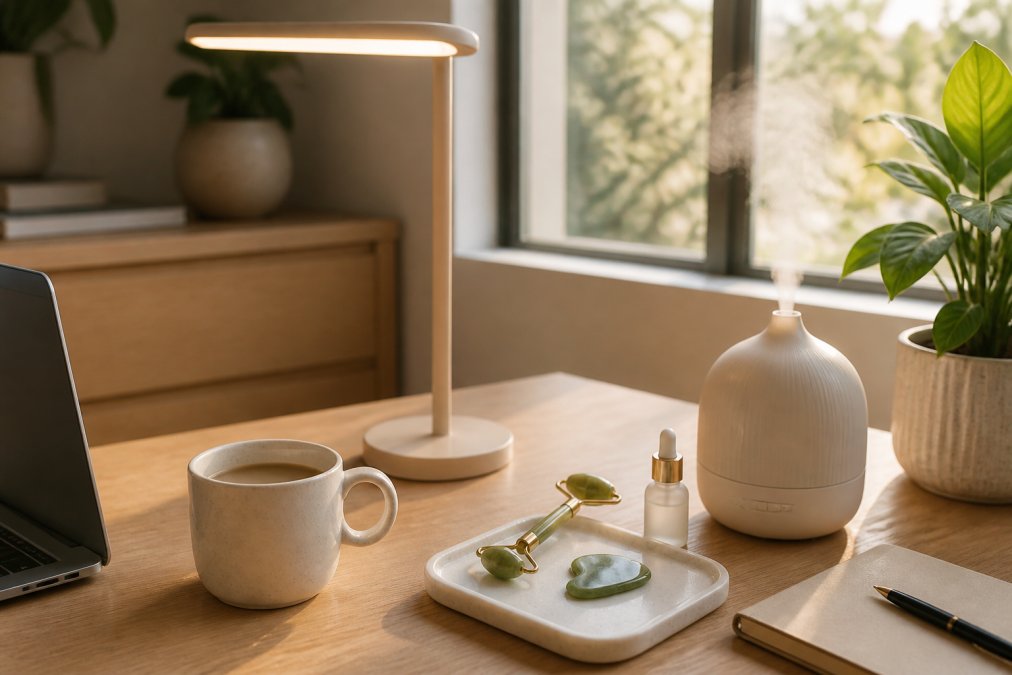
The anti-gravity purified air humidifier ($39.99) is the clearest example. It produces a nano-fine mist while water droplets appear to flow backward, and it doubles as a quiet aroma diffuser for a study, bedroom, or office. For a home office, the practical benefit is real: dry air from heating and air conditioning dries out eyes and sinuses during long screen sessions, and a humidifier running at a low, near-silent setting addresses that without a visible tank dominating the desk (the EPA).

For a bedside setup, the Bluetooth bedside speaker with wireless charging ($149.99) combines dual 5W speakers, a 10W Qi charging pad, and adjustable LED lighting in a maple finish. It replaces three separate objects with one, speaker, phone charger, and lamp, which is the actual clutter-management argument, not just the visual one.
The Intelligent G shaped LED lamp with wireless charging ($102.76) does something similar for a desk: 15W fast charging, a Bluetooth speaker, sleep lighting, and ten customizable light color modes in one piece. The 15W output matters because it is fast enough to top up a phone during a workday.
The workspace-integration test
Before a design-forward device earns a spot on your desk, run it through four questions:
- Does it replace something you already own? A lamp that also charges your phone and plays audio replaces three objects. A lamp that only lights is one more object.
- Does it share a cable or outlet? Devices that charge over USB-C or Qi reduce the cable sprawl that makes a home office look improvised.
- Does it fit the surface you actually have? Measure the footprint against your desk or nightstand before buying. A beautiful device that crowds your keyboard will end up in a drawer.
- Does it run quietly enough for calls? Humidifiers, diffusers, and speakers all produce noise. Check the decibel level or reviews from people who use them on video calls.
Maintenance and clutter management
Every design-forward device still needs cleaning, refilling, or charging. A simple rule keeps the aesthetic intact: one device per surface, and one consumable per device. A humidifier needs water and occasional descaling. A diffuser needs oil. A charging lamp needs nothing but a cable. The fewer consumables a device requires, the more likely it stays in rotation past month one.
What to Ignore: Common Bad Advice About Wellness Tech
Most bad advice about wellness tech falls into three categories: claims that a device replaces professional care, claims that more features mean better results, and claims that you need a subscription for everything.
Start with the first one. No at-home device diagnoses or treats a medical condition. Devices support recovery, relaxation, and skin health. They do not replace a doctor, and any product page suggesting otherwise should be treated with suspicion.
The second problem is feature bloat. Buy for the problem you have, not the spec sheet.
The third is the subscription trap. Plenty of good options are one-time purchases with no ongoing cost, which is worth checking before you commit.
A final note on maintenance: every device you add needs cleaning, charging, and storage. Three well-chosen tools you actually use beat ten that sit in a cabinet.
Conclusion
Building a wellness setup that survives a busy schedule is harder than buying one. The devices that stick are the ones that fit an existing habit, look good enough to stay visible, and solve one clear problem each.
The Pure Shelf curates exactly this kind of product: skincare tools, recovery devices, and home pieces chosen for style and value, with free shipping and returns so you can try something without risk. Start with one device, use it for a month, and add the next only when the first has earned its place. Shop the collection at The Pure Shelf and build a routine that actually holds up.
Frequently Asked Questions
What should I look for in stylish wellness devices for busy professionals?
Focus on three things: how quickly you can use it (under 10 minutes), whether it fits your existing space without adding clutter, and if it has real functional benefits like LED therapy or heat massage. The Neck & Face Lifting LED Therapy Device at $24 takes 5-10 minutes daily and targets fine lines. Look for devices that serve a clear purpose rather than collecting dust.
Can wellness devices help reduce professional burnout?
Devices that address physical tension and sleep quality can help. The Electric Wrist Massager ($47.99) uses EMS pulse technology to relieve strain from typing, while the Topical Magnesium Spray ($40) supports sleep and muscle recovery. Pairing these with a consistent routine gives your body recovery tools without requiring a full schedule overhaul. The key is consistency, not intensity.
How do I integrate wellness gadgets into a busy work schedule?
Attach them to habits you already have. Use the Gua Sha Facial Massager & Jade Roller Set ($18) right after your morning face wash. Keep the Handheld Body Sculpting Massager ($36) at your desk for a two-minute break between meetings. Apply the magnesium spray 20-30 minutes before bed. When a device slots into an existing routine, you actually stick with it.
What are the trends in wellness products for 2026?
Three trends stand out: devices that double as decor (like the Anti-Gravity Humidifier at $39.99), multi-function gadgets that combine charging with lighting or audio, and at-home tools that replace spa visits. LED therapy devices and EMS massagers are growing because they deliver visible results in short sessions. Buyers want fewer, better devices that earn their counter space.
Are wearable wellness devices for professionals worth the investment?
It depends on what you need. The Smart Knee Massager ($72) and Electric Wrist Massager ($47.99) target specific pain points from desk work and physical activity. Unlike general fitness trackers, these devices deliver direct physical relief. If you deal with wrist strain or knee discomfort regularly, a targeted device at under $75 costs less than two professional massage sessions.
Leave a comment