

Best Beauty Tools for Fine Lines: 2026 Comparison

Table of Contents
- Quick Comparison: Best Beauty Tools for Fine Lines
- Neck & Face Lifting LED Therapy Device: Best for Collagen Support
- Microcurrent Device Benefits: What It Actually Does for Fine Lines
- How to Use Facial Rollers for Anti-Aging: Gua Sha & Jade Roller Set
- Best Skincare Routine for Fine Lines: Layering Serums with Tools
- Safety, Contraindications & Realistic Timelines for Beauty Tools
- Long-Term Costs & Maintenance: What to Expect
- Conclusion
- Frequently Asked Questions
Last Updated: September 17, 2026
Quick Comparison: Best Beauty Tools for Fine Lines
The best beauty tools for fine lines are the ones you will actually use every day, not the ones with the longest feature list. The tools that work share three traits: a clear mechanism, a short session time, and a price that does not punish consistency.
Quick Picks:
- Best Overall: Neck & Face Lifting LED Therapy Device ($24.00), light-based collagen support in 5-10 minutes a day
- Best for Puffiness and Sculpting: Gua Sha Facial Massager & Jade Roller Set ($18.00), manual lymphatic drainage and contour work
- Best Serum Pairing: Hyaluronic Acid Anti-Aging Serum ($19.99), plumps skin so lines look softer
| Tool | Price | What It Targets | Session Time | Best For |
|---|---|---|---|---|
| Neck & Face Lifting LED Therapy Device | $24.00 | Collagen support, firmness | 5-10 min | Fine lines and sagging |
| Gua Sha & Jade Roller Set | $18.00 | Puffiness, jawline contour | 5 min | Morning depuffing |
| Collagen Peptide Eye Cream | $15.99 | Crow's feet, dark circles | 1 min | Delicate eye area |
| Hyaluronic Acid Serum | $19.99 | Dryness, fine lines | 1 min | Layering under tools |
| Vitamin C Brightening Serum | $15.99 | Dullness, texture | 1 min | Morning radiance |
Neck & Face Lifting LED Therapy Device: Best for Collagen Support
Red light therapy delivers specific wavelengths of light into the epidermal layer, supporting the skin's own collagen production. The Neck & Face Lifting LED Therapy Device from The Pure Shelf brings that mechanism home for $24.00, non-invasive and suitable for all skin types.

- What it does: LED therapy for skin rejuvenation, lifting, and tightening
- Session time: 5-10 minutes daily
- Where it wins: It covers the neck, the area most tools ignore and the first place fine lines and crepiness show
- The tradeoff: It needs daily consistency. Skip a week and progress stalls
Microcurrent Device Benefits: What It Actually Does for Fine Lines
What most guides miss is that microcurrent is a maintenance tool, not a permanent fix. Results fade when you stop, and sessions typically run several times a week. If you want a device that asks less of your schedule, LED therapy is the easier habit to keep. For guidance on how at-home devices fit into a broader routine, the American Academy of Dermatology's skin care resource center outlines how dermatologists approach at-home anti-aging tools.
How to Use Facial Rollers for Anti-Aging: Gua Sha & Jade Roller Set
Learning how to use facial rollers for anti-aging is mostly about direction and pressure. The Gua Sha Facial Massager & Jade Roller Set ($18.00) reduces puffiness, relieves muscle tension, and sculpts the jawline through gentle lymphatic drainage in about five minutes morning and night.

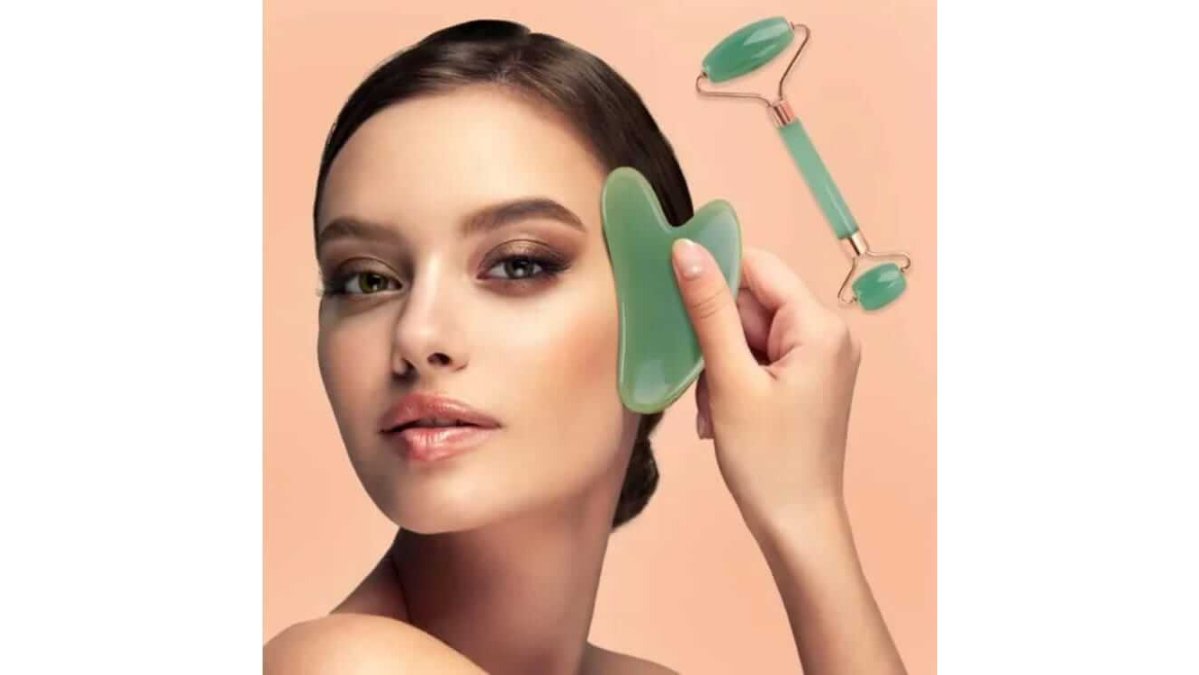
Work in this order:
- Start at the center of the face and sweep outward and upward
- Use light pressure only; dragging the skin causes irritation, not lift
- Follow the jawline toward the ears for contouring
- Finish down the neck to encourage lymphatic flow
- Chill the gua sha in the fridge for extra depuffing
Best Skincare Routine for Fine Lines: Layering Serums with Tools
The best skincare routine for fine lines pairs hydration with stimulation, in that order. Serums create the plumped base that makes lines look softer, and tools support collagen and circulation underneath. Neither works as well alone.
Layer it like this:
- Step 1: Cleanse and tone
- Step 2: Apply 2-3 drops of Hyaluronic Acid Anti-Aging Serum ($19.99) to damp skin
- Step 3: Use your LED device or gua sha
- Step 4: Tap on Collagen Peptide Eye Cream ($15.99) around the eyes
- Step 5: Finish with moisturizer to seal hydration
Safety, Contraindications & Realistic Timelines for Beauty Tools
Safety protocols matter more than most buyers expect, and this is the section most roundups skip. At-home devices are gentle by design, but "gentle" is not the same as "safe for everyone." The mechanism matters: LED delivers light energy into skin cells. Each carries its own list of people who should not use it.

Who should avoid which tool
Skip all powered devices and check with a physician first if you:
Neck & Face Lifting LED Therapy Device →
- Have a pacemaker, implanted defibrillator, or any other implanted electronic device (microcurrent and RF are the highest concern here, since they send current or heat through tissue)
- Are pregnant or breastfeeding (electrical and RF devices are typically avoided as a precaution; LED is generally considered lower risk, but confirm with your OB)
- Have epilepsy or a seizure disorder (some LED and microcurrent devices carry warnings)
- Have active skin infections, open wounds, cold sores, or a fresh breakout in the treatment area
- Have a diagnosed skin condition such as rosacea, eczema, or melasma, confirm with a dermatologist before starting, since heat and stimulation can trigger flares
- Have metal implants, dental plates, or permanent fillers in the treatment area (RF and microcurrent especially)
- Are taking photosensitizing medications such as isotretinoin or certain antibiotics (LED and any light-based tool)
Microneedling at home carries an extra caution: never share a roller or stamp, never use one over active acne or broken skin, and never combine it with strong exfoliating acids or retinoids in the same session. The micro-channels you create are also a pathway for bacteria and for ingredients that would otherwise sit on the surface.
Which skincare actives to pause when using tools
- Retinoids (tretinoin, retinol, adapalene): do not layer under microneedling or RF. Barrier disruption pushes the active deeper and raises the risk of redness and peeling. Use them on alternate nights.
- AHA/BHA acids (glycolic, lactic, salicylic): skip on the same night as microneedling or RF. With LED and gua sha, they are generally fine.
- Vitamin C: fine with LED and gua sha. With microneedling, some people find it stings; patch test first.
- Hyaluronic acid and basic moisturizers: the safest pairing across every tool, which is why a plain HA serum is the recommended base layer.
- Benzoyl peroxide and other drying actives: pause around microneedling sessions.
Realistic timelines: what actually happens when
Most articles promise "instant results." Here is the honest version, by what is physically happening in the skin.
- Puffiness and depuffing (gua sha, jade roller, chilled tools): visible after a single session. This is lymphatic drainage, not a structural change, and it fades within hours.
- Hydration and plumpness (serums, HA): a few days of consistent use. This is water binding in the upper layers, and it reverses if you stop.
- Skin texture and radiance (LED, gentle exfoliation): several weeks. Surface cell turnover runs on roughly a four-week cycle.
- Fine lines and firmness (LED, microcurrent, RF): two to three months of regular use for the earliest visible change. Collagen remodeling is slow, new collagen is laid down over weeks and matures over months. Microcurrent gives a faster temporary lift (hours to a day) because it works on muscle, but that is not collagen change.
- Full collagen response: most practitioners find the meaningful structural change shows up between the three- and six-month mark with consistent use, and it plateaus rather than continuing indefinitely.
Long-Term Costs & Maintenance: What to Expect
This is the section almost no roundup includes, and it decides whether a tool is actually a good deal. The sticker price is not the cost. The cost is the sticker price plus everything you buy to keep using it for a year.
The real cost of ownership
- LED therapy device ($24.00): no consumables, no replacement heads, no gels. Used daily for a year, that is roughly 7 cents per session, the lowest cost-of-ownership category in the anti-aging tool market.
- Gua sha and jade roller set ($18.00): zero ongoing cost. Clean it, dry it, use it for years. The only "consumable" is the occasional replacement if a stone chips.
- Microcurrent devices: the device itself is the cheap part. The conductive gel is the ongoing cost, most brands require a water-based gel or primer for the current to travel, and a tube runs out every few weeks. Budget for it monthly.
- Radio-frequency (RF) devices: many require a conductive gel, and some treatment heads have a limited lifespan. Check the replacement-head price before you buy, it is often the biggest hidden cost.
- Microneedling rollers and stamps: replacement heads are the consumable. A roller head is good for a limited number of uses before the needles dull, and dull needles cause more irritation than sharp ones.
- Serums and eye creams: the routine layer. A 15ml Hyaluronic Acid Serum at twice-daily use lasts roughly a month, so budget for about 12 bottles a year. The Collagen Peptide Eye Cream and Vitamin C serum run on similar cycles.
At-home vs. professional: the honest comparison
Professional in-office treatments, RF tightening, professional microneedling, laser resurfacing, carry per-visit pricing far higher than any at-home device, and require repeat appointments to maintain results. The trade-off is real: in-office treatments are performed by trained providers, use higher energy levels, and reach depths an at-home device cannot. At-home tools trade peak intensity for frequency and cost.
Maintenance that actually matters
- Wipe device surfaces after every use with a soft cloth or an alcohol wipe on non-porous parts. Do not submerge powered devices.
- Clean gua sha and jade rollers with warm water and mild soap, then dry fully before storing. Stone tools stored damp can grow bacteria.
- Replace microneedling heads on schedule, not when they "look" dull. Follow the manufacturer's use count.
- Check battery and charging contacts periodically. A device that is not holding a charge is not delivering full output.
- Store everything dry and out of direct sunlight. Heat and UV degrade both electronics and stone.
- Track your serum usage so you reorder before you run out, a gap in the routine is the most common reason people lose progress.
Conclusion
The hard part is not finding tools. It is staying consistent long enough to see results, which is where most routines collapse. The Pure Shelf curates beauty and skincare essentials chosen for quality and value, with free shipping and returns, so trying a device does not feel like a gamble. Start with the LED therapy device for collagen support, add the gua sha set for daily depuffing, and pair both with the Hyaluronic Acid Serum for hydration.
Frequently Asked Questions
What actually works for fine lines and wrinkles?
A combination of at-home tools and targeted skincare delivers the most visible results. LED therapy devices stimulate collagen production and improve skin texture. Pairing these with hydrating serums like hyaluronic acid and collagen peptide eye cream helps plump the skin. Consistency matters more than intensity, so using tools alongside a solid routine yields gradual improvements.
Do microcurrent devices really help with fine lines?
Microcurrent devices deliver low-level electrical currents that stimulate facial muscles and boost circulation. Users often notice firmer skin and reduced puffiness after several weeks of regular use. The effects are cumulative, so results fade if you stop. For fine lines specifically, microcurrent works best as part of a broader anti-aging regimen that includes hydration and sun protection. It is non-invasive and generally safe for most skin types.
How often should you use anti-aging beauty tools?
Most at-home devices are designed for daily or every-other-day use. LED therapy devices can be used 5-10 minutes per day, while facial rollers are typically recommended 3-5 times weekly. Overuse can irritate sensitive skin, so start with shorter sessions and gradually increase. Always follow the manufacturer's instructions and give your skin rest days if you notice redness or sensitivity.
Are LED light therapy masks effective for skin aging?
LED light therapy has shown promise for improving skin tone, reducing fine lines, and supporting collagen production. Red light and near-infrared wavelengths penetrate the epidermal layer to stimulate cellular turnover. At-home devices offer lower intensity than professional treatments, so results take longer. They are safe for all skin types and pair well with serums that boost hydration and radiance.
What should I look for when buying an at-home facial tool?
Focus on safety, ease of use, and compatibility with your skin type. Look for devices with clear instructions, adjustable intensity, and dermatologist-tested materials. Consider long-term costs, including replacement parts. If you have sensitive skin or medical conditions like rosacea, check contraindications first. A simple tool you will actually use daily beats a complex one that sits in a drawer.
Leave a comment