

Are At-Home Beauty Devices Worth It? An Honest 2026 Review

Table of Contents
- What At-Home Beauty Devices Actually Do (And What They Don't)
- At-Home Facial Device Safety Standards You Should Know
- Comparing the Devices: Features, Prices, and Who Each One Is For
- How to Build a Simple Skincare Routine with Your Device
- Long-Term Costs, Maintenance, and E-Waste: The Hidden Side of At-Home Devices
- How to Measure Results Objectively (So You Know It's Working)
- Conclusion: Are At-Home Beauty Devices Worth It for You?
- Frequently Asked Questions
Last Updated: September 11, 2026
What At-Home Beauty Devices Actually Do (And What They Don't)
Search "are at home beauty devices worth it" and you'll find influencers promising glass skin in a week and skeptics calling the category a waste of money. The truth: at-home beauty devices are consumer-grade tools that use light, microcurrent, vibration, or manual massage to support skin and muscle health between professional treatments. They work, but on a smaller scale than a clinic.
This guide from The Pure Shelf breaks down what each device type does, what it can't do, and how to decide whether one belongs in your routine.
Most at-home devices fall into a few categories, each with a different mechanism and ceiling:
- Light-based tools (LED, high-frequency) target collagen production and acne-causing bacteria
- Microcurrent devices use low-level electrical currents to stimulate facial muscles
- Manual tools (gua sha, jade rollers) support lymphatic drainage and skin texture
- Vibration and massage devices address muscle tension, circulation, and cellulite appearance
The key distinction: at-home devices support skin health over weeks and months, while professional treatments deliver stronger, faster results under trained supervision. Expect in-office results from a handheld tool and you'll be disappointed; want a low-cost way to maintain your skin between appointments, and the math changes.

LED light therapy: how it works
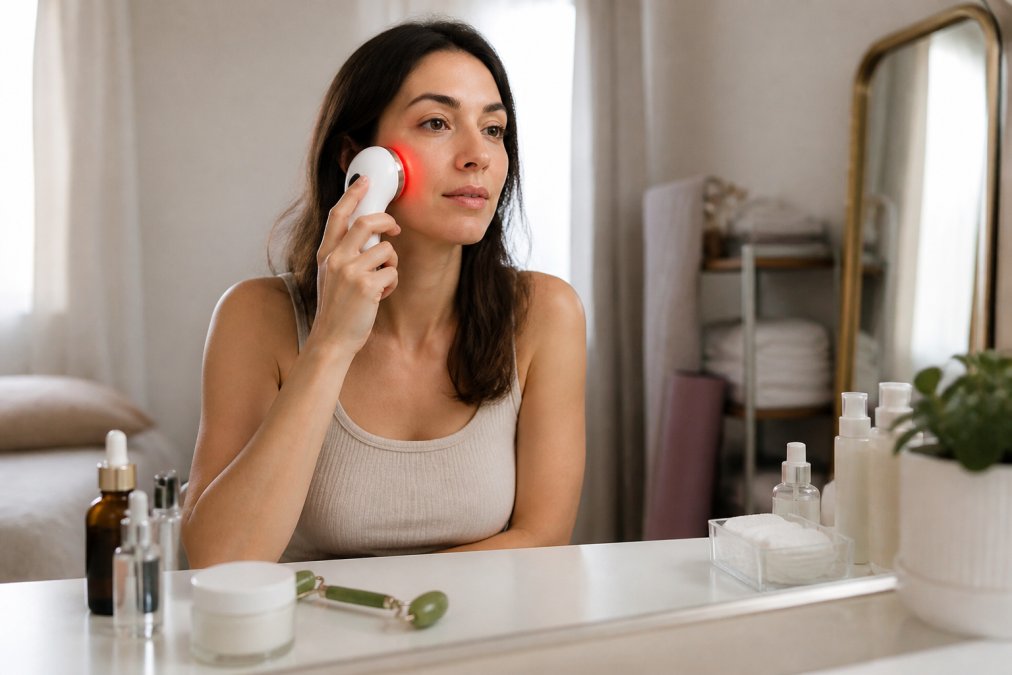
LED light therapy uses specific wavelengths to stimulate cellular activity. Red light penetrates deeper to support collagen production; blue light targets acne-causing bacteria on the surface. It's the same technology used professionally at higher intensity.
At-home LED devices run at lower power for safety, which means results take consistency, not intensity. The FDA's guidance on light-based devices classifies many of these tools as Class II devices, meaning manufacturers must meet specific safety standards before selling them.
What you can realistically expect: gradual improvement in skin tone, fine lines, and mild breakouts over 8-12 weeks of regular use.
The benefits of microcurrent devices
Microcurrent devices send low-level electrical currents through facial muscles to encourage contraction and tone. The benefits of microcurrent devices center on visible firmness and contour, not structural change, a workout for your face, where muscles respond but need repeated sessions to hold the effect.
The catch is compliance: results fade within days if you stop, which is why most brands recommend 3-5 sessions per week. Skip that schedule and you're paying for a device that sits in a drawer.
At-Home Facial Device Safety Standards You Should Know
At-home facial device safety standards exist for a reason: these tools interact with your skin barrier, and improper use causes irritation, burns, or worse. The regulatory picture is more layered than most product pages admit. The Consumer Product Safety Commission oversees general consumer device safety, while the FDA regulates devices making medical claims. Many LED, microcurrent, and radiofrequency tools are cleared as Class II devices, which means manufacturers must meet specific performance and labeling standards before selling them. That clearance is not the same as a clinical endorsement, and it does not mean the device is right for every user.
A few baseline rules apply across categories:
- Never use a device on broken, sunburned, or irritated skin
- Follow the manufacturer's session time exactly; more is not better
- Clean conductive gel off thoroughly after microcurrent sessions
- Store LED devices away from direct heat and moisture
- Check for recalls before buying any electrical facial tool
- Discontinue use if you notice persistent redness, tingling, or numbness
If a device causes pain, stop. Discomfort is not a sign it's working.
Contraindications for specific medical conditions
Certain conditions make at-home devices a bad idea, and this is the part most product pages bury. Risk differs by device type, so treat the list below as a starting filter, not a diagnosis.
Skip LED, microcurrent, and high-frequency devices entirely if you:
- Have a pacemaker, implanted defibrillator, or any implanted electronic device
- Are pregnant (microcurrent and radiofrequency especially)
- Have active skin infections, cold sores, or open wounds in the treatment area
- Take photosensitizing medications like certain antibiotics, diuretics, or acne treatments
- Have epilepsy or a seizure disorder (some light-based tools can trigger sensitivity)
- Have metal implants, dental plates, or orthopedic hardware in the treatment path
Use extra caution and get medical clearance first if you:
- Have rosacea, eczema, or psoriasis, redness reduction is a selling point on many product pages, but the wrong device can make these conditions worse
- Have an autoimmune condition affecting the skin, such as lupus or scleroderma
- Are using prescription retinoids or recently had chemical peels, microneedling, or laser treatments
- Have diabetes with reduced sensation in the treatment area
- Have a history of keloid scarring
Device-specific notes worth knowing:
- Microcurrent is generally off-limits for anyone with a pacemaker or seizure history, and some practitioners advise against it for those who are pregnant or breastfeeding.
- Radiofrequency tools generate heat and carry a higher burn risk for people with sensory neuropathy or impaired circulation.
- LED devices are the lowest-risk category, but photosensitizing medications and some eye conditions still warrant a conversation with a clinician.
- Vibration plates and body massagers are not safe for everyone either, skip them if you are pregnant, have a hernia, recent fractures, or joint replacements without medical clearance.
If you have a chronic skin condition or any implanted medical device, ask a dermatologist or primary care provider before starting any device routine. A five-minute conversation is cheaper than treating a burn or an interaction.
Comparing the Devices: Features, Prices, and Who Each One Is For
At-home beauty devices range from simple manual tools to powered gadgets, and the right pick depends on your concern, budget, and how much time you'll actually commit. Here's how five devices from The Pure Shelf's collection stack up.
| Device | Price | Best For | Type |
|---|---|---|---|
| Neck & Face Lifting LED Therapy Device | $24.00 | Fine lines, firmness | LED light |
| Gua Sha & Jade Roller Set | $18.00 | Puffiness, jawline definition | Manual |
| Handheld Body Sculpting Massager | $36.00 | Cellulite, muscle tension | Vibration |
| Smart Knee Massager | $72.00 | Joint pain, recovery | Heat + vibration |
| Vibration Plate Exercise Machine | $83.32 | Circulation, light fitness | Vibration |
Neck & Face Lifting LED Therapy Device - Tighten, Lift & Smooth
This is the entry point for anyone curious about light therapy. At $24.00, the Neck & Face Lifting LED Therapy Device uses LED light to support collagen production and improve blood circulation across the face and neck. Sessions run 5-10 minutes and suit all skin types.

Where it wins: the price makes it easy to test LED therapy without committing to a $200+ device. Where it falls short: lower intensity than premium options, so consistency matters more. Use it daily for the first month before judging results.
Gua Sha Facial Massager & Jade Roller Set
The Gua Sha Facial Massager & Jade Roller Set at $18.00 is the lowest-commitment device here, and the one most people stick with. It reduces puffiness, relieves muscle tension, and helps sculpt the jawline through manual lymphatic drainage.
Pair it with a serum for glide. The set works best morning and night, and it's gentle enough for daily use on all skin types.
Handheld Body Sculpting Massager
For stubborn cellulite and muscle soreness, the Handheld Body Sculpting Massager at $36.00 offers four massage heads and adjustable speeds. It's corded, weighs just over a pound, and targets tension in the back, legs, and shoulders.

The vibration therapy relaxes tight muscles and improves the appearance of cellulite over time. It's not a weight-loss tool, and anyone selling it as one is overselling. As a recovery device, it earns its place.
Smart Knee Massager for Pain Relief & Recovery
The Smart Knee Massager at $72.00 sits outside the beauty category but fits the broader at-home wellness device question. Heat therapy and vibration combine to soothe knee pain, reduce inflammation, and improve circulation. Fifteen intensity levels, cordless design, and a wrap-around fit for most knee sizes.
Best for anyone with arthritis, sports injuries, or daily knee fatigue. It's a recovery tool, not a skincare device, so don't buy it expecting complexion results.
Vibration Plate Exercise Machine
At $83.32, the Vibration Plate Exercise Machine is the highest-ticket item here. It's a fitness and circulation tool, not a facial device, but it belongs in the conversation because "at-home beauty" often overlaps with body wellness.
Use it for light workouts, balance training, and circulation support. It won't replace a gym routine, and results depend entirely on how often you step on it.
How to Build a Simple Skincare Routine with Your Device
Learning how to build a simple skincare routine around a device is less complicated than most guides suggest. The order matters more than the number of steps.
A workable sequence:
- Cleanse with a gentle, non-stripping cleanser
- Apply conductive gel if using microcurrent, or a serum for gua sha
- Run your device session for the recommended time
- Remove gel or excess product with a soft cloth
- Apply moisturizer to seal in hydration
- Finish with SPF in the morning (non-negotiable)
Skip the ten-step routine. Three to four products plus one device is enough for most people. According to the American Academy of Dermatology's skincare guidance, a consistent basic routine outperforms an inconsistent complex one every time.
Long-Term Costs, Maintenance, and E-Waste: The Hidden Side of At-Home Devices
The purchase price is the visible cost. The hidden costs are replacement parts, conductive gel, and the device itself when it stops working. Most at-home devices last 1-3 years with regular use, and many aren't repairable, an angle most reviews skip, and one that changes the math on whether a device is worth it.
The real cost of ownership over 2-3 years
A $200 LED mask and a $24 LED device are not the same purchase, but neither is a one-time expense. Add these to the sticker price:
- Conductive gel for microcurrent devices: a typical 8-ounce bottle runs $15-$30 and lasts roughly 2-3 months with regular use. Over two years, that's $120-$360 in gel alone, often more than the device itself.
- Replacement heads and attachments for massage and cleansing tools: brush heads and massage nodes commonly run $10-$40 each and need replacing every 3-6 months.
- Battery replacement or charging degradation: cordless devices with sealed lithium batteries often lose capacity within 18-24 months, and many cannot be serviced.
- Replacement device: if the unit fails outside warranty, you're buying again. Most warranties run 1 year, sometimes 2.
A realistic two-year total for a mid-range microcurrent device can land between $300 and $600 once gel and a possible replacement are factored in. A gua sha set at $18 with no consumables has a two-year cost of $18. That gap is the single most underreported number in the category.
Maintenance that actually extends device life
- Wipe LED panels and metal contacts with a soft, dry cloth after every session, residue blocks light output and corrodes contacts
- Never submerge a powered device unless the manufacturer explicitly rates it waterproof
- Store microcurrent and radiofrequency tools away from humidity; bathrooms without ventilation shorten electronics life
- Charge cordless devices to roughly 50% before long storage rather than leaving them full or fully drained
- Keep the original box and manual, some warranties require proof of purchase and serial number
The e-waste question
Beauty devices are electronics, and electronics become e-waste. Small consumer electronics are among the fastest-growing waste streams, and most beauty gadgets aren't designed for repair or recycling. Before buying, ask:
- Does the brand sell replacement parts, or is the whole unit disposable?
- Is the battery replaceable by the user?
- Does the manufacturer offer a take-back or recycling program?
- Can you recycle the device at end of life through a local electronics drop-off?
The EPA's guidance on electronics recycling covers how to dispose of small electronics responsibly. A device you use daily for three years is a reasonable environmental trade-off. A device you use twice and abandon is not.
How to Measure Results Objectively (So You Know It's Working)
Most people judge device results by feel, which is why so many give up before seeing change. Track it properly instead.
- Photograph your skin in the same lighting, same angle, same time of day, weekly
- Note specific concerns (fine lines, redness, breakouts) and rate them 1-10 each week
- Log sessions so you know your actual compliance rate
- Wait 8-12 weeks before drawing conclusions; early changes are subtle
Conclusion: Are At-Home Beauty Devices Worth It for You?
So, are at home beauty devices worth it? For most people, yes, with realistic expectations. They won't replace a dermatologist or deliver clinic-grade results, but they offer a low-cost, non-invasive way to support skin health, reduce puffiness, and maintain results between professional treatments.
The Pure Shelf curates devices at prices that make testing easy: the $18.00 Gua Sha & Jade Roller Set for daily puffiness, the $24.00 Neck & Face Lifting LED Therapy Device for collagen support, and the $36.00 Handheld Body Sculpting Massager for recovery. Free shipping and returns mean you can try something without the risk of a bad fit.
Get started with The Pure Shelf and build a routine you'll actually keep.
Frequently Asked Questions
Do at-home skin tightening devices really work?
They can produce modest, gradual improvements, but not the dramatic lift you get from in-office treatments. LED devices like the Neck & Face Lifting LED Therapy Device ($24.00) support collagen production over weeks of consistent use. Microcurrent tools may temporarily tone facial muscles. Results depend on regular use and realistic expectations. Most at-home beauty devices are best for maintaining skin quality, not replacing professional procedures.
Are there any safety risks associated with at-home beauty tools?
Yes, though they are generally low-risk when used as directed. Common issues include skin irritation from overuse, burns from heat-based tools, and eye exposure to LED light. People with pacemakers, epilepsy, active acne cysts, or recent fillers should check with a doctor before using microcurrent or radiofrequency devices. Always follow the at-home facial device safety standards in the manual, start on the lowest intensity, and stop if you notice redness or pain that persists.
How do at-home microcurrent devices compare to professional treatments?
Professional microcurrent sessions use higher-intensity currents and are performed by trained estheticians, often costing $150 to $300 per visit. At-home devices deliver lower power for safety, so results are subtler and require more frequent use, typically 5 to 10 minutes daily. The benefits of microcurrent devices at home include convenience and no recurring appointment costs, but they will not match the immediate lift of an in-office session.
What should you look for when buying a beauty device?
Check the wavelength and intensity levels for LED tools, the material and build quality, and whether the brand publishes clear safety instructions. Look for a device that fits your specific concern, whether that is fine lines, puffiness, or muscle tension. A simple option like the Gua Sha Facial Massager & Jade Roller Set ($18.00) works well for lymphatic drainage and jawline sculpting without any electrical components. Buy from a seller with free returns so you can try it risk-free.
How long before you see visible results from at-home beauty devices?
Most devices need 4 to 12 weeks of consistent use before you notice visible results. LED therapy typically shows skin texture and redness reduction improvements around week 6 to 8. Microcurrent gives a temporary lift after each session, with cumulative firmness appearing after a month. Track your progress with photos taken in the same lighting every two weeks. If you see nothing after three months of regular use, the device may not suit your skin concern.
Leave a comment