

Why Quality Home Decor Costs More: A 2026 Guide

Table of Contents
- The Real Reasons Quality Home Decor Costs More
- How to Spot High Quality Furniture and Decor
- Durable Home Decor Materials That Justify the Price
- The Hidden Costs Behind Every Decor Price Tag
- Minimalist Home Decor Essentials for Small Apartments
- Cost-Per-Use, Resale Value, and the Psychology of Perceived Value
- Sustainability, Ethical Labor, and Material Sourcing Transparency
- Conclusion
- Frequently Asked Questions
Last Updated: September 16, 2026
The Real Reasons Quality Home Decor Costs More
Walk through any home store and you'll notice the gap immediately: a mass-produced accent chair for a modest sum, and a handcrafted hardwood piece for several times that. Why quality home decor costs more comes down to four forces that cheap manufacturing hides. This guide from The Pure Shelf breaks down each one, so you can tell real value from a marked-up label.
Quality home decor is furniture and decorative pieces built with durable materials, skilled construction, and finishes meant to last years rather than seasons.
Handmade Craftsmanship vs Mass-Production
Handmade pieces cost more because a person, not a machine, builds them. An artisan might spend hours on joinery a factory stamps out in seconds, that time is the price difference.
Material Sourcing and Raw Material Costs
Solid hardwood costs far more than particleboard or veneer over engineered wood, the difference is both the material and how it's sourced and processed.
How to Spot High Quality Furniture and Decor
You can judge most furniture in under two minutes with your hands and eyes. Ignore the price tag and inspect the construction, quality shows up in details cheap manufacturing can't fake.
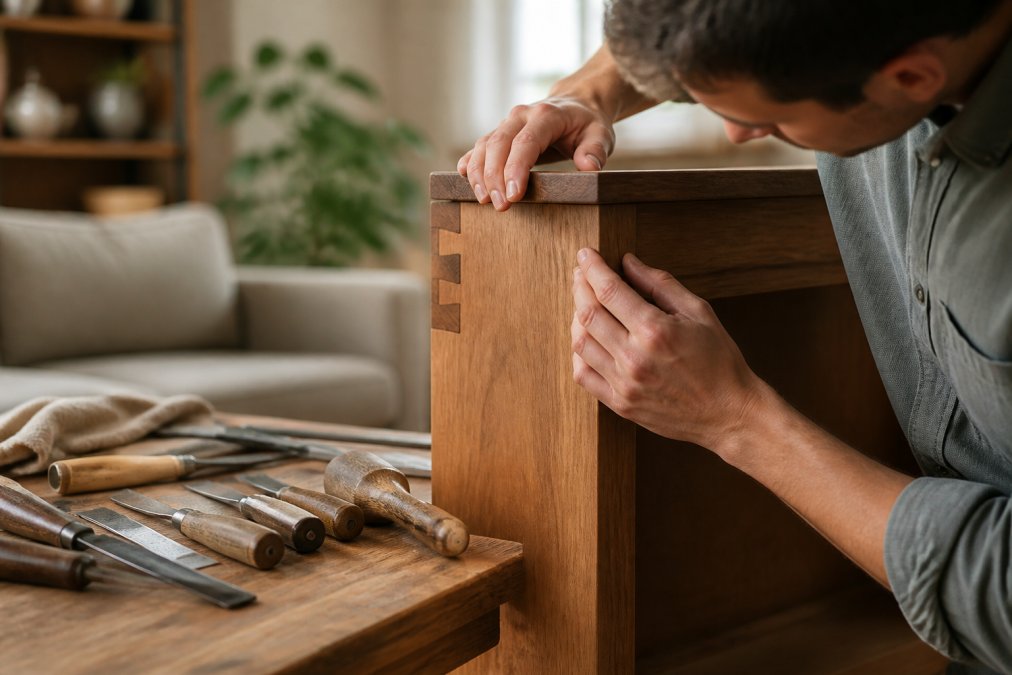
Start with these checks:
- Turn it over. Look at the underside and back. If they're unfinished or stapled, the maker cut corners.
- Feel the joints. Dovetail and mortise-and-tenon joints signal real construction. Glue and staples signal speed.
- Check the weight. Solid hardwood is heavy. If a large piece feels light, it's likely hollow or composite.
- Look at the finish. An even, smooth finish with no drips or bubbles means quality control.
Joinery, Finishes, and Quality Control Signals
Good joinery is the clearest quality signal in furniture. Dovetail joints in drawers and mortise-and-tenon joints in frames hold up under daily use; staples and glue fail first.
Durable Home Decor Materials That Justify the Price
Some materials simply cost more to produce and last longer, and that's where the price is earned. Solid hardwood, kiln-dried lumber, full-grain leather, and natural stone carry higher raw material costs but resist wear that destroys cheaper alternatives.
The Hidden Costs Behind Every Decor Price Tag
A retail price is not just materials plus labor. Several hidden costs sit between the factory and your living room, and the biggest ones are not glamorous, freight, damage, storage, and returns.
Design Fees, Manufacturing Overhead, and Retail Markup
Design fees cover the work of creating a piece before a single unit is built. A well-designed item fits a space, holds up to use, and looks right for years, work mass-produced copies often skip.
Why Heavy, Bulky Goods Cost So Much to Move
Furniture is one of the most expensive categories to ship because it is heavy, bulky, and easily damaged. A sofa does not travel like a phone. It travels like a sofa.
- Freight class and dimensional weight. Carriers price large, light items by the space they occupy, not just their weight. A bulky chair can cost more to ship than a denser, heavier box because it wastes trailer volume.
- Container economics. Imported goods move in shipping containers. A maker who fills a container efficiently spreads freight cost across many units; a maker shipping small batches pays a disproportionate share per piece.
- Damage and replacement. Solid wood and stone can crack, chip, or scratch in transit. Every damaged unit that gets replaced or refunded is a cost the seller recovers across the rest of the inventory.
- Last-mile delivery. White-glove delivery, the kind where someone carries the piece in, assembles it, and hauls away packaging, can add a meaningful surcharge per item. That service is often built into the price of higher-end pieces.
- Warehousing and storage. Goods that sit in a warehouse before selling accrue rent, insurance, and handling costs. Slow-moving, high-quality pieces often sit longer than fast-turning cheap ones.
| Cost Layer | What It Covers | Effect on Price |
|---|---|---|
| Raw materials | Lumber, fabric, hardware | Higher-grade materials raise cost |
| Skilled labor | Craftsmanship, assembly | Handwork costs more than machines |
| Design fees | Planning and prototyping | Quality design adds upfront cost |
| Manufacturing overhead | Factory, tools, quality control | Small-scale production costs more per unit |
| Freight and dimensional weight | Container space, carrier class | Bulky goods cost more per unit to move |
| Damage and returns | Replacement, refunds, reverse logistics | Higher damage rates raise the average price |
| Last-mile delivery | White-glove service, assembly | Premium service adds a per-item surcharge |
| Retail markup | Store costs, staff, returns | Wholesale-to-retail gap adds a layer |
Minimalist Home Decor Essentials for Small Apartments
Small spaces reward quality over quantity, because every piece has to earn its place. Minimalist home decor essentials for small apartments are fewer, better items that do more than one job. A single well-made lamp that also charges your phone beats three cheap ones that just sit there.
Intelligent G shaped LED lamp with →
The right essentials for a compact space:
- Multi-function lighting. A bedside lamp with wireless charging and a speaker replaces three separate devices.
- Soft, adjustable light. Warm, dimmable lighting makes a small room feel larger and calmer.
- One statement piece. A single well-crafted object carries more presence than a cluttered shelf.
- Motion-sensing night lights. Practical for hallways and tight spaces where you don't want to wake others.
Cost-Per-Use, Resale Value, and the Psychology of Perceived Value
The sticker price tells you what you pay once; cost-per-use tells you what a piece actually costs over its life. A well-built item used daily for years often costs less per use than a cheap one replaced every season, the single most useful tool for judging whether a higher price is worth it.

How to Run a Cost-Per-Use Comparison
The math is simple: divide the purchase price by the number of times you expect to use the piece. The hard part is estimating lifespan honestly.
- Estimate realistic years of use. A solid wood dining table used daily might last 15-20 years with minor refinishing. A particleboard table under the same use often fails in 3-5 years as joints loosen and surfaces swell.
- Divide price by uses. A $1,200 table used daily for 15 years works out to roughly 22 cents per day. A $300 table replaced every 4 years costs about 21 cents per day, and you buy it nearly four times, plus the hassle of disposal and replacement.
- Add the hidden costs. Cheap pieces often carry extra costs: replacement shipping, assembly time, and the labor of hauling old furniture out. Those rarely show up in the sticker price but they are real.
Which Decor Holds Value and Which Depreciates Instantly
Resale value separates decor into two rough categories.
- Holds value reasonably well: solid wood case goods, well-made upholstery from known makers, hand-knotted rugs, solid brass and quality metal fixtures, and classic silhouettes that stay in demand.
- Depreciates almost immediately: trend-driven accent pieces, particleboard and veneer furniture, mass-produced decor tied to a specific season or fad, and anything that is hard to clean or repair.
The reason is straightforward: resale buyers pay for durability and timelessness, not original marketing. A piece that can be cleaned, repaired, and restyled keeps a floor under its value; one that cannot usually sells for a fraction of what was paid.
The Psychology of Perceived Value
Perceived value works differently from actual value. Buyers read weight, texture, and finish as quality signals, which shape what feels "worth it", that is why a solid, heavy piece feels more valuable than a light one, even before you check the label.
Sustainability, Ethical Labor, and Material Sourcing Transparency
Durable decor is often the more sustainable choice, because you buy less over time. A piece that lasts a decade keeps materials out of landfills and reduces demand for constant replacement.
Conclusion
The gap between cheap and quality decor comes down to labor, materials, design, and the hidden costs of getting a piece to your door. Once you can spot real construction, you stop paying premium prices for ordinary goods.
Frequently Asked Questions
What makes quality home decor cost more than cheaper alternatives?
Quality home decor costs more because of material sourcing, skilled labor, and quality control. Solid hardwood, artisanal joinery, and hand-applied finishes take longer to produce than mass-production methods. Manufacturing overhead, supply chain logistics, and retail markup add to the final price. Each step adds durability and longevity that cheaper decor often lacks.
How can you tell the difference between cheap and quality home decor?
Check construction details. Quality pieces use joinery like dovetails or mortise-and-tenon instead of staples or screws. Look at material sourcing: hardwood and natural upholstery fabrics outperform particleboard and synthetic blends. Feel the weight, inspect the finishes, and check for consistent quality control. A quality vs. price checklist helps you evaluate value before buying.
Is it better to buy cheap decor or save for quality pieces?
Saving for quality pieces usually pays off through cost-per-use and resale value. A $102.76 Intelligent G shaped LED lamp with wireless charging that lasts years costs less per use than three $35 lamps that break. Quality decor also holds aesthetic value longer, while cheap trends cycle out fast. Budgeting for investment pieces reduces long-term spending.
What durable home decor materials justify a higher price?
Solid hardwood, kiln-dried lumber, natural stone, and high-density upholstery foam justify higher prices through longevity. These durable home decor materials resist warping, fading, and wear better than particleboard or synthetic blends. Material sourcing transparency from the maker confirms what you are paying for.
Leave a comment