

10 Minimalist Kitchen Essentials for Beginners

Table of Contents
- Why a Minimalist Kitchen Works for Beginners
-
The 10 Minimalist Kitchen Essentials
- 1. Chef's Knife and Paring Knife
- 2. Cutting Boards and Prep Surfaces
- 3. Cast Iron Skillet and Stainless Steel Cookware
- 4. Measuring Cups, Spoons, and a Scale
- 5. Multi-Purpose Utensils
- 6. Mixing Bowls and Colander
- 7. Kitchen Shears and Y-Peeler
- 8. Food Processor or Immersion Blender
- 9. Basic Bakeware
- 10. Storage Containers
- Best Multi-Purpose Kitchen Gadgets to Save Space
- Your Minimalist Kitchen Checklist for Smart Shopping
- How to Organize a Minimalist Kitchen
- Final Thoughts: Start Small and Build as You Cook
- Frequently Asked Questions
Last Updated: September 9, 2026
Why a Minimalist Kitchen Works for Beginners
Starting a kitchen from scratch is overwhelming when every store aisle pushes a new gadget. Minimalist kitchen essentials for beginners solve this by focusing on tools that earn their place through daily use.
A minimalist kitchen is a collection of versatile, durable tools that cover most cooking tasks without redundancy. Below, we’ll walk through the 10 items that form a complete starter setup, the best multi-purpose gadgets, and a shopping checklist.
The 10 Minimalist Kitchen Essentials
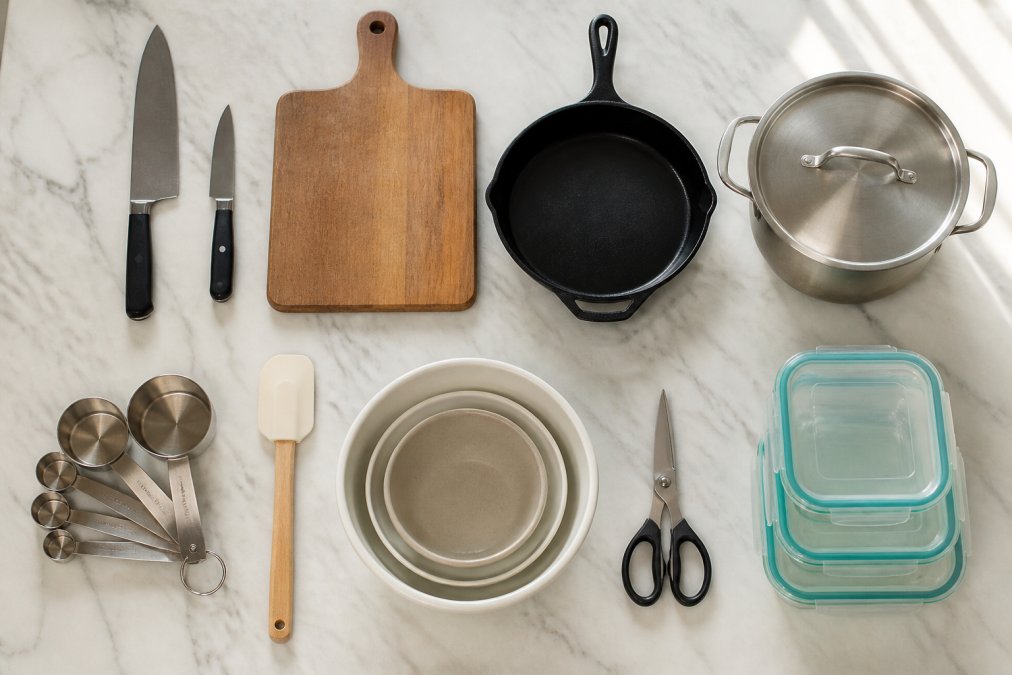
These ten items are the foundation of any efficient cooking space, chosen for versatility, durability, and the ability to perform multiple jobs well.
1. Chef's Knife and Paring Knife
The chef's knife is the single most important tool in your kitchen. An 8-inch chef's knife handles chopping, slicing, dicing, and mincing for nearly every ingredient. A small paring knife complements it for detail work like peeling fruit or deveining shrimp. Invest in a quality chef's knife with a comfortable handle; it will last for decades. A common mistake is buying a knife set when two well-chosen blades cover 95% of prep work.
2. Cutting Boards and Prep Surfaces
You need two cutting boards: one for produce and one for raw meat to prevent cross-contamination. A large wooden or bamboo board is gentle on your knife's edge, while a smaller plastic board is dishwasher-safe and ideal for proteins. Oil wooden boards monthly to prevent cracking.
3. Cast Iron Skillet and Stainless Steel Cookware
A 10- to 12-inch cast iron skillet is the most versatile pan you can own. It sears steaks, bakes cornbread, fries eggs, and roasts vegetables with excellent heat distribution. Cast iron is nearly indestructible and improves with age. Pair it with a 3-quart stainless steel saucepan for boiling pasta, simmering sauces, and cooking grains. Together, these two pieces replace an entire set of non-stick pans.
4. Measuring Cups, Spoons, and a Scale
Baking demands precision, and cooking benefits from it. A set of nested measuring cups and spoons covers dry and liquid ingredients, while a digital kitchen scale ensures accuracy for flour and dough. For minimalist kitchen essentials for beginners, this trio is non-negotiable.
5. Multi-Purpose Utensils
You don't need a drawer full of single-use tools. A silicone spatula handles folding, scraping, and stirring; tongs grip, flip, and serve; and a whisk whips eggs and smooths sauces. These three utensils replace a dozen specialized gadgets.
6. Mixing Bowls and Colander
A set of nesting mixing bowls serves as prep stations, serving dishes, and storage vessels. Look for stainless steel bowls with a non-slip base; they're lightweight and won't absorb odors. A colander strains pasta, rinses produce, and drains canned beans. Nesting bowls save cabinet space, and a colander that fits inside your largest bowl stores efficiently.
7. Kitchen Shears and Y-Peeler
Kitchen shears are the most underrated tool in a minimalist kitchen. They cut poultry, snip herbs, and open packaging. A Y-peeler makes quick work of carrots and potatoes, and its ergonomic shape reduces hand strain. Both tools are small, inexpensive, and eliminate the need for specialized gadgets.
8. Food Processor or Immersion Blender
For blending soups or making sauces, you need one of two appliances. A full-size food processor handles larger batches but takes up significant counter space. An immersion blender blends directly in the pot, reducing cleanup and storage needs. For a minimalist kitchen, the immersion blender is usually the better choice.
9. Basic Bakeware
A single quarter-sheet pan and a 9x13 baking dish cover most baking and roasting needs. The sheet pan roasts vegetables and bakes cookies; the baking dish handles casseroles, lasagna, and roasted chicken. Choose heavy-gauge steel or ceramic for even heat distribution and longevity.
10. Storage Containers
Glass storage containers with airtight lids store leftovers, pack lunches, and keep pantry staples fresh. Glass is non-porous, so it won't stain or retain odors like plastic. A set of four to six containers in assorted sizes covers most needs. Clear glass lets you see contents at a glance, which cuts down on food waste.
Best Multi-Purpose Kitchen Gadgets to Save Space
The real space-saving win comes from choosing tools that collapse multiple functions into one footprint. Here are the specific categories worth considering, along with the honest trade-offs of each.
The Dutch Oven: The One-Pot Workhorse
A 5.5-quart enameled cast iron Dutch oven is the closest thing to a do-everything vessel (americastestkitchen.com). It replaces a stockpot, a deep fryer, a bread cloche, a slow cooker, and a roasting pan. You can sear a roast on the stovetop, deglaze, add vegetables and broth, then transfer the whole pot to a 325°F oven, no extra pans. For no-knead bread, it traps steam to create a crackly crust. The trade-off is weight and cost: a quality enameled Dutch oven from Le Creuset or Staub runs $300-$400, though Lodge offers a serviceable version for around $80. On a tight budget, a stainless steel stockpot covers 80% of the same ground for about $50.
The Immersion Blender: Countertop Freedom
An immersion blender with a detachable shaft and blending cup replaces a full-size blender for most home cooking tasks. It purees soups directly in the pot and emulsifies vinaigrettes in a mason jar, no transferring hot liquids, no heavy base taking up counter space. The trade-off is texture: it won't crush ice or grind nuts as finely as a high-speed countertop blender. If your cooking leans toward soups and sauces, the immersion blender wins; for daily green smoothies, you'll want the countertop machine.
The Sheet Pan: Your Oven's Best Friend
A single half-sheet pan (18 x 13 inches) is the most underrated multi-purpose tool in a minimalist kitchen. It's a baking sheet for cookies, a roasting pan for sheet-pan dinners, and a catch tray for a dripping pie. Buy a heavy-gauge aluminum pan, Nordic Ware's commercial-grade half-sheet pan is the industry standard at about $20, and it will outlast a dozen flimsy non-stick cookie sheets. Avoid non-stick coatings entirely; they scratch, peel, and end up in landfills.
The Colander That Does Double Duty
A stainless steel colander with a flat base and two sturdy handles does more than drain pasta. It rinses produce and steams vegetables when placed over a pot of simmering water. Choose one that nests inside your largest mixing bowl so it stores flat.
The Rule That Actually Works
Forget the vague "does it replace three things?" test, it's too easy to rationalize a purchase. Instead, use the 30-day rule: put the gadget on your shopping list, then wait 30 days. If you still want it after a month of cooking with your core ten items, you've identified a genuine gap.
Your Minimalist Kitchen Checklist for Smart Shopping
A checklist is only useful if it comes with a plan. Here's a phased approach that works whether you're starting from zero or paring down an existing collection.
Phase 1: The $100 Starter Kit
If you're on a tight budget, you can build a functional minimalist kitchen for about $100. This isn't the lifetime kit, it's the kit that gets you cooking immediately while you save for upgrades:
- Chef's knife: A Victorinox Fibrox 8-inch chef's knife runs $40-$45. It's the knife most culinary schools recommend for students because it holds an edge surprisingly well for the price and has a comfortable, slip-resistant handle (ice.edu).
- Cutting board: A 12 x 18-inch polypropylene board from OXO or a restaurant supply store costs $10-$15. It's dishwasher-safe and gentle enough on your knife edge for everyday use.
- Cast iron skillet: A Lodge 10.25-inch pre-seasoned skillet is $20-$25. It's made in the USA, nearly indestructible, and performs as well as skillets costing three times as much.
- Stainless steel saucepan: A 3-quart stainless steel saucepan with a lid from Cuisinart or Tramontina runs $30-$40. It handles boiling pasta, simmering sauces, and cooking grains.
- Silicone spatula and tongs: Two basic heat-resistant tools from OXO or Di Oro cost $15-$20 combined.
That's roughly $115-$145 total. To hit the $100 mark, skip the saucepan initially and use the cast iron skillet for everything, then add the saucepan the following month. This prevents the most common beginner mistake: buying 15 cheap items at once instead of five decent ones.
Phase 2: The Upgrade Path
Once you've cooked for a month or two with your starter kit, you'll know which tools feel limiting. That's the signal to upgrade, not before. Beginners often find the Victorinox blade too thin for heavy root vegetable chopping, justifying a forged chef's knife from Wüsthof or Zwilling ($150-$200). Others find the Lodge skillet's rough surface makes delicate fish stick, pointing toward a smoother pan.
The 10-Item Checklist With Budget Tiers
Here's the full checklist with realistic price ranges for each tier. These are street prices from major retailers as of this writing, not sale prices:
| Item | Budget Tier | Mid-Range Tier | Premium Tier |
|---|---|---|---|
| Chef's knife (8-inch) | Victorinox Fibrox ($45) | MAC MTH-80 ($175) | Wüsthof Classic Ikon ($200) |
| Paring knife | Kuhn Rikon ($10) | Victorinox ($15) | Wüsthof ($50) |
| Cutting boards (2) | Polypropylene ($20) | Bamboo set ($35) | End-grain maple ($100+) |
| Cast iron skillet | Lodge ($25) | Lodge enameled ($80) | Le Creuset ($200+) |
| Stainless saucepan | Cuisinart ($35) | All-Clad ($150) | Demeyere ($250+) |
| Measuring cups/spoons | OXO ($15) | OXO steel ($30) | Williams Sonoma ($50) |
| Digital scale | Ozeri ($12) | Escali ($25) | Oxo ($50) |
| Silicone spatula/tongs/whisk | OXO ($25) | Di Oro ($40) | Le Creuset ($60) |
| Mixing bowls (nesting) | OXO ($30) | Cuisinart steel ($50) | Luminarc glass ($80) |
| Colander | OXO ($15) | Cuisipro ($25) | All-Clad ($60) |
| Kitchen shears | OXO ($15) | Wüsthof ($40) | Shun ($60) |
| Y-peeler | Kuhn Rikon ($5) | OXO ($10) | Messermeister ($15) |
| Immersion blender | Cuisinart ($40) | Breville ($100) | Bamix ($200) |
| Sheet pan | Nordic Ware ($20) | USA Pan ($25) | Matfer ($35) |
| Baking dish (9x13) | Pyrex ($15) | Le Creuset ($150) | Staub ($200) |
| Glass storage containers | Pyrex set ($30) | Weck ($50) | OXO ($60) |
The One-Question Filter
Before any purchase, ask: "Will this replace something I already own, or will it add to my collection?" If it adds, it must earn its place by solving a problem you've encountered in the last 30 days of cooking.
- Chef's knife and paring knife
- Two cutting boards (wood and plastic)
- Cast iron skillet and stainless steel saucepan
- Measuring cups, spoons, and digital scale
- Silicone spatula, tongs, and whisk
- Nesting mixing bowls and colander
- Kitchen shears and Y-peeler
- Immersion blender or food processor
- Sheet pan and baking dish
- Glass storage containers
How to Organize a Minimalist Kitchen
How to organize a minimalist kitchen starts with decluttering: remove everything you haven't used in the past year and donate or recycle it. Then, group tools by function and store them near their point of use. Keep the chef's knife on a magnetic strip near your prep area, hang pots and pans on a wall rack, and use drawer dividers to keep utensils visible.
A minimalist kitchen organization system relies on vertical space and clear surfaces. Store everyday items at eye level and reserve upper cabinets for occasional-use pieces. Clear countertops of appliances you don't use daily. This approach makes cooking more enjoyable because everything has a home and is easy to find. According to research on kitchen organization and cooking frequency, an organized kitchen encourages people to cook at home more often, which supports healthier eating habits.
Final Thoughts: Start Small and Build as You Cook
The minimalist kitchen essentials for beginners listed here are a starting point, not a rigid rulebook. Start with the chef's knife, cutting board, and cast iron skillet, then add pieces as your cooking skills grow. The goal is to avoid buying gadgets that sit unused in a drawer.
As you build your collection, focus on maintenance and longevity. Sharpen your chef's knife regularly, season your cast iron skillet, and oil your wooden cutting board. These small habits extend the life of your tools. For quality storage and organization solutions that complement a minimalist kitchen, explore curated home essentials. Get started and build a kitchen that makes cooking simpler, smarter, and more enjoyable.
Frequently Asked Questions
What is the most versatile item for a minimalist kitchen?
A chef's knife is the most versatile tool you can own. It handles roughly 80% of your prep work, from chopping vegetables to slicing meat. Invest in a quality 8-inch blade that feels comfortable in your hand. Pair it with a paring knife for smaller tasks, and you can skip most other specialty cutters. A good knife reduces prep time and makes cooking more enjoyable.
How do I decide which kitchen gadgets are actually essential?
Focus on tools that serve multiple purposes. For example, a cast iron skillet can sear, bake, and fry, replacing several single-use pans. Before buying anything, ask if you will use it at least once a week. If the answer is no, leave it off your minimalist kitchen checklist. This approach keeps your drawers clutter-free and your budget intact.
What should a beginner buy for their first minimalist kitchen setup?
Start with the core items: a chef's knife, cutting board, cast iron skillet, stainless steel pot, measuring cups and spoons, and a few multi-purpose utensils like a spatula and tongs. This foundation covers most recipes. Add a food processor or immersion blender only if you cook often. A minimalist kitchen essentials list for beginners rarely needs more than 20 items.
How can I downsize my kitchen tools without sacrificing functionality?
Audit your drawers and remove duplicates or single-use tools you have not touched in months. Replace multiple items with one multi-purpose alternative, such as using an immersion blender instead of a full blender and food processor. Store items you use daily within reach and pack away seasonal tools. This decluttering method keeps your kitchen organized and functional.
Leave a comment