

How to Choose Quality Wellness Products: 7-Step Guide

Table of Contents
- Start With Your Health Goal, Not the Shelf
- How to Read Wellness Product Labels Without Getting Fooled
- Why Third-Party Supplement Testing Is the Strongest Quality Signal
- Wellness Product Safety Standards and the Rules Behind the Label
- Check Storage, Shelf Life, and Sourcing Before You Commit
- Budget vs. Quality: Where Paying More Actually Matters
- How to Choose Quality Wellness Products That Fit Your Routine
- Frequently Asked Questions
Last Updated: September 19, 2026
Start With Your Health Goal, Not the Shelf
Most people shop for wellness products backwards: they spot an attractive bottle and reverse-engineer a reason to buy it, ending up with a cabinet of half-used supplements. Learning how to choose quality wellness products starts with one question: what outcome are you trying to support? This guide from The Pure Shelf walks through our seven-step process.
Match the Product Format to the Goal
The format should follow the goal. For better sleep, a topical or capsule may suit you differently than a powder; for digestive comfort, a liquid tincture between meals often fits a routine better than a large tablet. The common mistake is buying the format a friend recommended instead of the one you will actually use. Consistency beats optimization almost every time.
How to Read Wellness Product Labels Without Getting Fooled
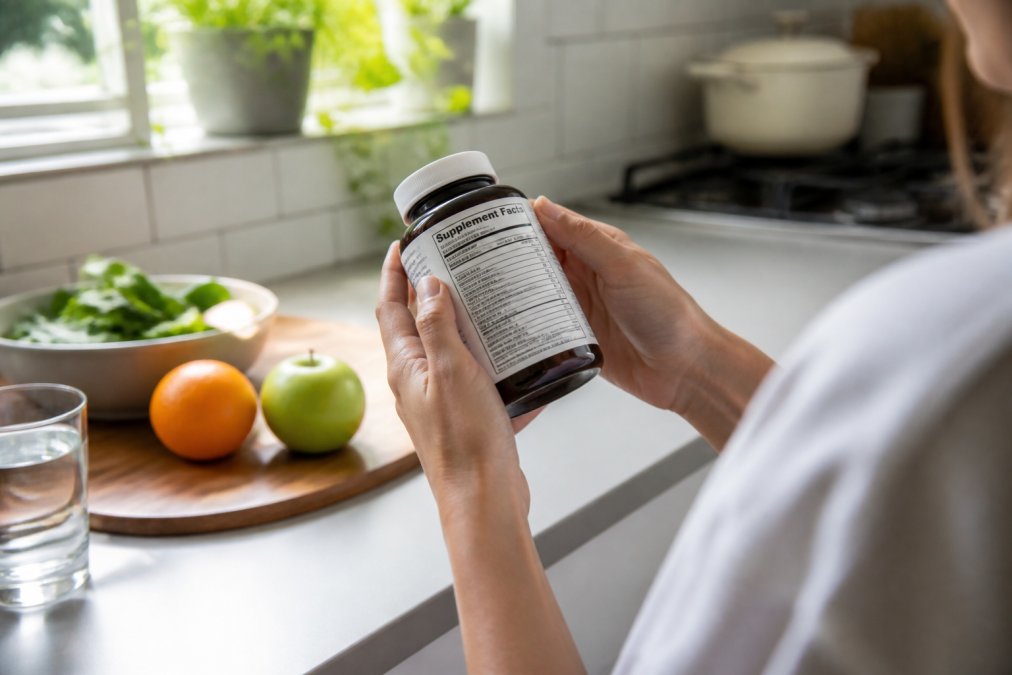
The front of a wellness product label is marketing; the back is information. Read the back in a specific order, because the panel is designed to be skimmed rather than studied. Start with the Supplement Facts panel, which lists every active ingredient and its amount per serving, then check the "Other Ingredients" line for fillers and binders. A short, recognizable list beats a long one full of unpronounceable compounds.
Decode the Supplemental Facts Panel in Four Passes
The panel tells you what is in the product and how much, but not whether the ingredient was tested for purity, that is where third-party testing comes in. Read it in this order:
- Serving size first. A bottle that says "60 servings" but lists a serving as half a capsule is not the same value as one that lists a full capsule. Multiply serving size by the number of servings to see what you are actually buying.
- Amount per serving, not per container. The number next to each ingredient is per serving. If you take two servings a day, double it before comparing to any reference intake.
- % Daily Value. This appears only for nutrients with an established Daily Value. Botanicals and most herbal extracts will show a blank or a dagger, that is normal, not a red flag, but it means you cannot lean on the %DV column for those rows.
- The footnote. The asterisk line explains that Daily Values are based on a 2,000-calorie diet. It is boilerplate, but its presence confirms the panel follows the standard format.
Proprietary Blends: The Most Common Label Trick
A proprietary blend lists several ingredients under one total milligram amount, for example, "Proprietary Energy Blend ... 500 mg" followed by five botanicals. You cannot tell how much of each is present; a blend could be 490 mg of the cheapest ingredient and 10 mg of the one you wanted. This is legal, and it is the easiest way for a brand to underdose an expensive ingredient while still printing its name.
Standardized Extracts, Allergens, and the Fine Print
Two more lines worth reading:
- "Manufactured in a facility that also processes...", this is a cross-contamination disclosure, not an ingredient list. It matters if you have a severe allergy.
- "These statements have not been evaluated by the Food and Drug Administration.", this disclaimer is required on structure/function claims. Its presence is normal; its absence on a product making health claims is a compliance problem.
Why Third-Party Supplement Testing Is the Strongest Quality Signal
Third-party supplement testing is the single most reliable indicator that a product contains what its label claims. An independent laboratory tests for potency, purity, and contaminants, then issues a report; if a brand will not share that report, treat it as a warning sign. Look for independent laboratory testing that screens for heavy metals, microbial contamination, and adulteration, with verifiable results rather than a marketing sentence.
Reading a Certificate of Analysis
A certificate of analysis reports what a testing lab found in a specific batch. Look for the batch number, testing date, methods used, and results for potency verification and heavy metal screening. If the certificate does not match the batch on your bottle, ask why.
Wellness Product Safety Standards and the Rules Behind the Label
Wellness product safety standards are enforced through a mix of federal rules and voluntary certification. The FDA regulates dietary supplements under a framework that treats them more like food than drugs, which means manufacturers are responsible for ensuring safety before a product reaches the shelf. The FDA's dietary supplement guidance explains what that framework does and does not require.
The Interaction Check Most Guides Skip
Here is the safety step almost no product label does for you: checking whether a supplement interacts with what you already take. It is the most under-covered area in wellness buying and where the real risk lives for most adults. A practical framework, in order:
- List everything you take, prescriptions, over-the-counter drugs, other supplements, and regular caffeine or alcohol. Interactions are cumulative, not one-to-one.
- Flag high-risk categories. Blood thinners (many botanicals affect clotting), thyroid medications (calcium and iron can block absorption), antidepressants (St. John's Wort is well-documented), and immunosuppressants (some herbal extracts alter drug metabolism).
- Check timing, not just combination. Taking a mineral supplement within a couple of hours of thyroid medication can reduce absorption even if the two are not chemically incompatible.
- Ask a pharmacist, not the brand. Pharmacists have interaction databases and no incentive to sell you the product.
- Re-check when anything changes. A new prescription, supplement, or dose is a reason to re-run the list.
Dosage: Where the Label Ends and Judgment Begins
A product label gives you a serving size, not a personalized dose. The %DV column offers a rough reference point for nutrients with an established Daily Value; botanicals and blends often have no printed upper limit at all. A few rules of thumb:
- Start at the low end. If a label offers a range, begin at the bottom and hold there for a week or two before increasing.
- More is not better for fat-soluble vitamins. Vitamins A, D, E, and K accumulate in the body rather than flushing out, so exceeding a stated upper limit over time is a real concern.
- Do not stack the same ingredient across products. A multivitamin, a sleep blend, and a stress formula can each contain magnesium or zinc. Add them up before you add a fourth.
- Treat "detox" and "cleanse" language as a marketing term, not a dosage instruction. There is no standardized meaning for either.
Certification Bodies Worth Recognizing
Beyond GMP, several third-party programs verify what a brand claims. You do not need to memorize them, just recognize that a seal from an independent body is a different signal than one a brand designed for itself. When you see a certification mark, look up who issued it and what they tested; a mark that only verifies paperwork is not the same as one that verifies the contents of the bottle.
Check Storage, Shelf Life, and Sourcing Before You Commit
Storage and shelf life are the quality factors almost nobody checks, and they are often the reason a product stops working before you finish the bottle.
- Check the expiration or "best by" date, and prefer products with at least several months remaining
- Store oils and liquids in a cool, dark place, as the label directs
- Note the product sourcing: where raw ingredients come from affects purity
- Look for sustainability and ethical sourcing statements if that matters to you
- Watch for changes in smell, color, or texture, which can indicate spoilage
Budget vs. Quality: Where Paying More Actually Matters
Spending more does not automatically buy better quality, but in some categories the price gap reflects real differences: independent testing, third-party certification, and higher-purity ingredients all cost money. A product priced far below its category is usually cutting one of those corners. Here is how we think about the trade-off:
| Category | Where Budget Works | Where Paying More Matters |
|---|---|---|
| Basic vitamins | Single-ingredient capsules | Chelated or specialized forms |
| Topical oils | Carrier oils for general use | Cold-pressed, hexane-free oils |
| Digestive support | Simple single-herb blends | Standardized multi-herb formulas |
| Sleep support | Basic magnesium | Topical or high-absorption formats |
How to Choose Quality Wellness Products That Fit Your Routine
- Does the format match your daily habits?
- Can you find the certificate of analysis for the batch?
- Is the ingredient list short and transparent?
- Does the label carry a recognizable certification?
- Is the price reasonable for the testing level claimed?
- Will you realistically use it consistently?
At The Pure Shelf, we curate products with exactly this filter: quality you can verify, at prices that make sense. Customer Jasmine R. put it simply: "Free shipping that's fast and quality products." Sarah M. added that "everything was exactly as described." That is the standard we hold.
Frequently Asked Questions
What criteria should I use to evaluate quality wellness products?
Start with four checks: a complete supplemental facts label with amounts per serving, third-party certification or a certificate of analysis you can request, a clear manufacturer name and address, and an expiration or best-by date. Then match the format to your goal. A topical magnesium spray, for example, delivers magnesium through the skin, while a capsule goes through digestion. Products that hide ingredient amounts behind proprietary blends make it harder to judge quality, so treat that as a warning sign.
How do I know if third-party supplement testing was actually done?
Look for a certification mark from an independent lab on the package, then check that the certifying body's website lists the product. For anything without a seal, email the brand and ask for a certificate of analysis covering potency verification, heavy metal screening, and ingredient purity. A brand doing real third-party supplement testing will send one within a day or two. If they cannot produce it, that tells you something about their quality assurance.
Are there specific certifications to look for when buying wellness items?
Yes. For dietary supplements, look for independent lab certification marks and a current good manufacturing practices audit. For skincare and botanical oils, look for organic certification and cold-pressed or hexane-free claims that are backed by a supplier name. For topical products, check that allergen warnings and full ingredient lists appear on the label. Any certification is only useful if you can verify it, so search the certifying organization's directory before you buy.
How do I store wellness products so they stay effective?
Heat, light, and moisture break down bioactive compounds faster than most people expect, so store oils and sprays in a cool, dark cabinet rather than a steamy bathroom shelf. The organic yoni oil listing from The Pure Shelf specifically notes storing it in a cool, dark environment to maintain potency. Check expiration dates every few months, and toss anything with a changed smell, color, or texture. A product past its date may still be safe but no longer delivers the dose on the label.
Choosing quality wellness products takes more attention than the shelf invites, but the process is not complicated. Verify the testing, read the back of the label, check the storage and sourcing, and match the format to your real routine. The Pure Shelf makes that easier with a curated selection of skincare and wellness essentials, free shipping and returns, and products chosen for verifiable quality and value. Get started with The Pure Shelf and build a wellness routine you can actually trust.
Leave a comment