

Best LED Light Therapy Devices of 2026: Full Guide

Table of Contents
- How We Found the Best LED Light Therapy Devices
- Red vs Blue Light Therapy Benefits: Which Do You Need?
- What to Look For in an LED Light Therapy Device
- How to Use LED Light Therapy Masks Safely
- LED Light Therapy Treatment Duration: A Realistic Timeline
- Our Top Pick: Neck & Face Lifting LED Therapy Device
- The Verdict: Choosing Your At-Home Device
- Frequently Asked Questions
Last Updated: September 4, 2026
How We Found the Best LED Light Therapy Devices
The market for at-home beauty tech has exploded, but separating clinical-grade tools from expensive novelties requires more than reading marketing copy. LED light therapy uses specific wavelengths of light to stimulate cellular activity, yet most devices fail to deliver the therapeutic dose needed for visible results.
Our team at The Pure Shelf evaluated dozens of devices against a strict rubric: wavelength accuracy, irradiance output, build quality, and real-world usability. We cross-referenced manufacturer claims with published research on photobiomodulation, the process by which light-emitting diodes penetrate the dermal layers to trigger mitochondrial function and boost collagen production. According to the National Institutes of Health literature on photobiomodulation, red light in the 630-660 nanometer range and near-infrared light around 810-850 nanometers are the most effective for skin health.
Most guides focus on app connectivity or fancy packaging, but those don't matter if the device doesn't deliver enough energy per square centimeter to influence cellular regeneration. We prioritized objective irradiance measurements over aesthetic appeal, which eliminated roughly half the contenders.
Many budget options use low-power LEDs that feel warm but never reach the therapeutic threshold. The best LED light therapy devices 2026 has to offer pair proper wavelength delivery with enough power to make consistent treatment worthwhile.
Red vs Blue Light Therapy Benefits: Which Do You Need?
Red light and blue light target different skin layers and biological pathways, so the right choice depends on your primary concern. Red light (630-660 nm) penetrates the dermis to stimulate mitochondrial activity in fibroblasts, increasing collagen and elastin production, the standard recommendation for fine lines, firmness, and texture (peer-reviewed research). Blue light (around 415 nm) is absorbed by porphyrins produced by Cutibacterium acnes, generating reactive oxygen species that kill the bacteria, but this mechanism is surface-level and does not meaningfully stimulate collagen.
The case for red light as your primary device. For most adults over 30, red light delivers the broader return on investment. Red and near-infrared wavelengths reduce inflammation, support wound healing, and improve blood flow, benefits that compound with consistent use. Blue light does nothing for existing scars, hyperpigmentation, or sagging. If acne is your only concern and you are under 25, a blue-light-focused device may suffice; otherwise, a dual-wavelength device is more practical.
What the clinical literature actually supports. The evidence base for red light is substantially stronger than for blue light. A 2014 systematic review in Photomedicine and Laser Surgery found consistent improvements in skin complexion, collagen density, and wrinkle reduction across multiple red light studies. Blue light research, while positive for acne lesions, is less standardized, with fewer long-term follow-ups. This asymmetry matters: you are investing in a device you will use for years, and the wavelength with the deeper evidence base is red.
A practical decision framework:
| Primary concern | Recommended wavelength | Why |
|---|---|---|
| Fine lines, loss of firmness | Red (630-660 nm) | Stimulates fibroblast collagen production |
| Active inflammatory acne | Blue (~415 nm) | Kills C. acnes at the skin surface |
| Acne + early aging | Dual red/blue | Covers both mechanisms in one session |
| Hyperpigmentation | Red or near-infrared | Reduces inflammation that drives melanin overproduction |
| Rosacea or redness | Red or near-infrared | Anti-inflammatory effects calm vascular reactivity |
The trade-off most guides skip: treatment time and coverage. Dual-wavelength devices often alternate between red and blue rather than emitting both simultaneously, doubling your session time. If time-constrained, a red-only device used consistently outperforms a dual device you abandon. Blue light is also more intense at eye level, many dual masks require stricter eye protection than red-only models.
One more consideration: near-infrared (810-850 nm). If your goals include jawline firmness or facial volume, near-infrared penetrates deeper than red light, reaching subcutaneous tissue where structural support degrades with age. Many high-end devices pair red and near-infrared LEDs in the same panel, offering the most complete coverage of the aging process.
What to Look For in an LED Light Therapy Device
Four specifications determine whether an LED device will actually work: wavelength, irradiance, treatment area, and build quality. Wavelength must match clinical research, irradiance determines whether you're getting a therapeutic dose, and treatment area dictates session length.
Irradiance is the spec most buyers overlook. Measured in milliwatts per square centimeter, this tells you how much light energy reaches your skin. Clinical-grade devices typically deliver 40-100 mW/cm². Many consumer masks fall short of this threshold, which means you'd need impossibly long sessions to see results. Look for published irradiance figures rather than vague claims about "clinical-grade" technology.
Wavelength accuracy matters just as much. A device claiming red light therapy should emit in the 630-660 nanometer range, not 590 or 700. Poorly manufactured LEDs drift from their rated wavelengths, reducing effectiveness. Reputable manufacturers publish their exact specs.
How to Use LED Light Therapy Masks Safely
LED light therapy is one of the safest at-home aesthetic technologies available, the FDA has cleared devices in this category as low-risk, and the non-ionizing radiation does not damage DNA or skin cells. But "safe" does not mean "no protocol." The two areas where users most often go wrong are eye protection and skincare integration.
Eye safety: what the manuals do not emphasize enough. The concern is not thermal damage, LEDs do not generate enough heat to harm the retina, but photochemical stress from prolonged exposure to bright light in the 400-500 nm range. Blue light is the primary concern; red and near-infrared are less phototoxic, though even red light at high irradiance can cause afterimages. If your mask includes opaque eye shields, use them. If it instructs you to close your eyes, do so for the entire session.
Skincare integration: the compatibility question most guides ignore. Apply LED therapy to clean, dry skin, no serums, moisturizers, or sunscreen. Light penetrates more efficiently through a bare stratum corneum, and any product film can scatter or absorb photons before they reach target cells.
After your session, the order matters. Post-treatment, your skin is mildly vasodilated, temporarily increasing absorption of topicals, the optimal window for humectants and antioxidants like hyaluronic acid and vitamin C. But there is an important caveat with photosensitizing ingredients:
| Ingredient | Safe with LED? | Guidance |
|---|---|---|
| Hyaluronic acid | Yes | Apply after session for enhanced absorption |
| Vitamin C (L-ascorbic acid) | Yes | Apply after; do not apply before (can cause stinging) |
| Retinol / retinoids | Caution | Use at night on non-LED days or at least 12 hours apart |
| Alpha-hydroxy acids (glycolic, lactic) | Caution | Can increase sensitivity; space by 24 hours if irritation occurs |
| Benzoyl peroxide | No | Photosensitizing; avoid same-day use |
| Doxycycline / minocycline (oral) | No | Photosensitizing; consult your dermatologist before starting LED |
| St. John's Wort (supplement) | No | Known photosensitizer; avoid concurrent use |
A common pattern among dermatologist-recommended routines: use LED in the morning after cleansing, then apply vitamin C and moisturizer. In the evening, use retinol on alternate nights, not immediately before or after an LED session, to prevent irritation while allowing both treatments to work.
Cleaning and maintenance: the overlooked safety factor. LED masks accumulate oil, dead skin cells, and bacteria. Most manufacturers recommend wiping the device with a 70% isopropyl alcohol wipe after every 3-5 uses. Do not submerge the device unless explicitly stated waterproof. Silicone masks like the Neck & Face Lifting LED Therapy Device can be wiped with a damp cloth and mild soap, then air-dried. Check the LED lens surface periodically, a film of product or oil can reduce irradiance by up to 30%.

Contraindications that warrant a dermatologist consult:
- Active, untreated skin lesions or suspected skin cancer
- Current use of photosensitizing medications (including certain antibiotics, diuretics, and antipsychotics)
- Pregnancy (no evidence of harm, but no long-term safety data either)
- History of light-sensitive disorders such as lupus or porphyria
The sustainability angle competitors miss. High-quality LED devices are meant to last 5-10 years, but most users replace them because the battery degrades or the charging port fails. Check whether the manufacturer offers replacement batteries or repair services. The Neck & Face Lifting LED Therapy Device uses a standard USB-C charging port, so you can replace the cable easily, a small detail that extends the device's usable life.
LED Light Therapy Treatment Duration: A Realistic Timeline
Most people abandon their LED devices within a month because they expect overnight results. Clinical protocols typically recommend 10-20 minute sessions, three to five times per week, for at least 8-12 weeks before evaluating results.
Here's what a realistic timeline looks like:
| Phase | Duration | Expected Changes |
|---|---|---|
| Weeks 1-2 | 10 min, 3x weekly | Skin feels calmer, subtle glow |
| Weeks 3-6 | 10-15 min, 4-5x weekly | Improved skin texture, reduced redness |
| Weeks 7-12 | 15-20 min, 4-5x weekly | Visible reduction in fine lines, firmer appearance |
| Months 4-6 | Maintenance, 3x weekly | Cumulative collagen production, brighter complexion |
Consistency beats intensity. A 10-minute daily session produces better results than a 60-minute weekly marathon. The cellular mechanisms driving collagen production need regular stimulation. Missing a day won't undo progress, but skipping weeks resets your timeline.
Pulsed light vs. continuous wave is another consideration. Some advanced devices offer pulsed modes that deliver light in rapid bursts, which some research suggests may enhance cellular response. However, continuous wave devices at proper irradiance remain the clinical standard for most at-home applications.
Our Top Pick: Neck & Face Lifting LED Therapy Device
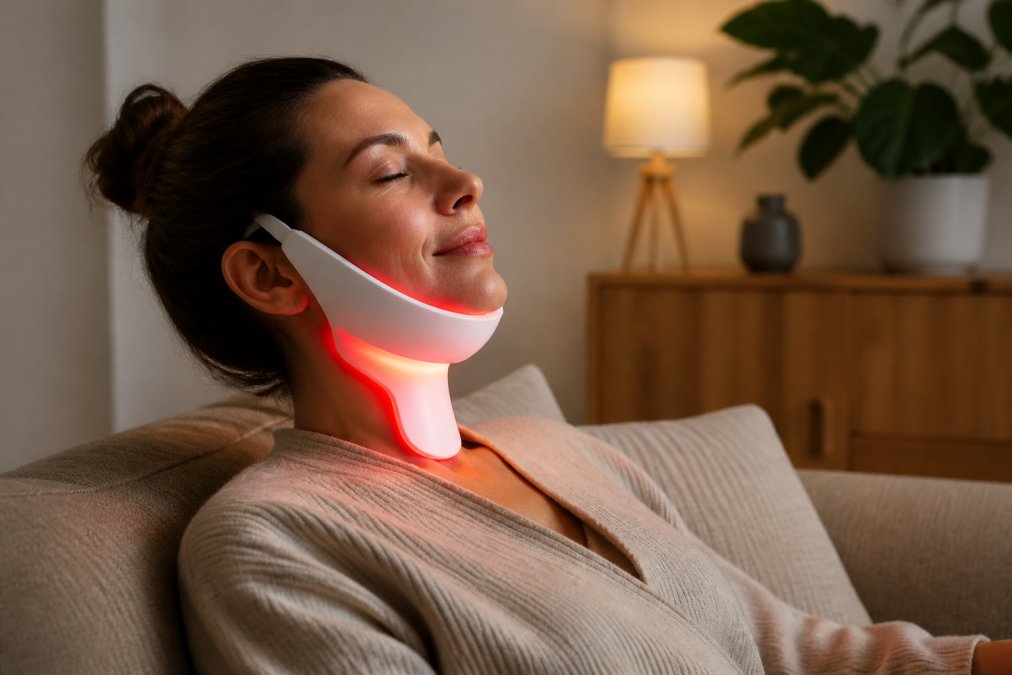
After evaluating all the criteria above, our top recommendation for most users is the Neck & Face Lifting LED Therapy Device from The Pure Shelf. It addresses a gap most competitors miss: the neck and jawline area, which often shows aging signs before the face does. Priced at $24.00, it makes LED light therapy accessible without sacrificing wavelength quality.
Its ergonomic design contours to the neck and lower face, areas flat panel masks can't reach effectively. The silicone flexibility allows it to sit flush against skin, ensuring consistent light delivery. It's designed to stimulate collagen production and improve blood circulation in just minutes per session.
For busy professionals, the low time commitment makes consistency achievable. The device integrates easily into an evening routine. Unlike full-body panels that require dedicated space, this portable option travels well and stores discreetly.
The Verdict: Choosing Your At-Home Device
The best LED light therapy devices 2026 has to offer share one trait: they make consistent use easy. A clinically perfect device you never touch delivers zero results.
Start by identifying your primary concern. For anti-aging and overall rejuvenation, red and near-infrared wavelengths deliver the broadest benefits. For active acne, seek blue light capability. Then verify wavelength accuracy, irradiance output, and FDA clearance status.
Our recommendation remains the Neck & Face Lifting LED Therapy Device for its combination of targeted design, accessible price point, and genuine therapeutic potential. At The Pure Shelf, we curate products that earn their place in your routine, and this device has proven itself with customers who value both results and simplicity.
The science behind LED light therapy is solid, and the technology has matured to the point where at-home treatment can genuinely complement professional care. As research on long-term photobiomodulation outcomes continues to validate the approach, these devices are becoming less of a luxury and more of a skincare essential. Your skin renews itself continuously; giving it the right light stimulus simply helps that process work more efficiently.
Choosing the right at-home LED device comes down to matching the technology to your skin goals and committing to a consistent routine. The Pure Shelf makes that decision easier with a curated collection of wellness devices that balance clinical credibility with everyday practicality. Explore the Neck & Face Lifting LED Therapy Device and experience how targeted light therapy can rejuvenate your skin from the comfort of home. Get started with The Pure Shelf and make LED light therapy a sustainable part of your self-care ritual.
Frequently Asked Questions
Are FDA-cleared LED light therapy masks worth the investment?
Yes, for consistent users. FDA clearance means the device's safety and claimed effects have been reviewed. Clinical studies show that regular use can boost collagen production and improve skin texture. The key is consistency. A quality mask used three to five times a week for the recommended treatment duration is more effective than an expensive one used occasionally.
How long does it take to see results from LED light therapy?
Most people see initial improvements in skin texture and radiance after about four to six weeks of consistent use. More significant changes, like a reduction in fine lines and wrinkles or improved elasticity, typically appear after eight to twelve weeks. This timeline aligns with your skin's natural cellular regeneration cycle. Patience and sticking to your treatment protocol are essential.
What is the difference between red and blue light therapy?
Red light therapy targets the dermal layers to stimulate collagen production and reduce inflammation, making it ideal for anti-aging and improving skin elasticity. Blue light therapy works on the skin's surface to kill acne-causing bacteria, making it best for managing active breakouts. Many modern devices combine both wavelengths to treat a wider range of concerns, from acne to fine lines.
This article was written using GrandRanker
Leave a comment